AI Model Terms Every Developer Should Understand
AI is becoming a core part of modern applications, but building with AI requires more than simply connecting an application to an LLM API.
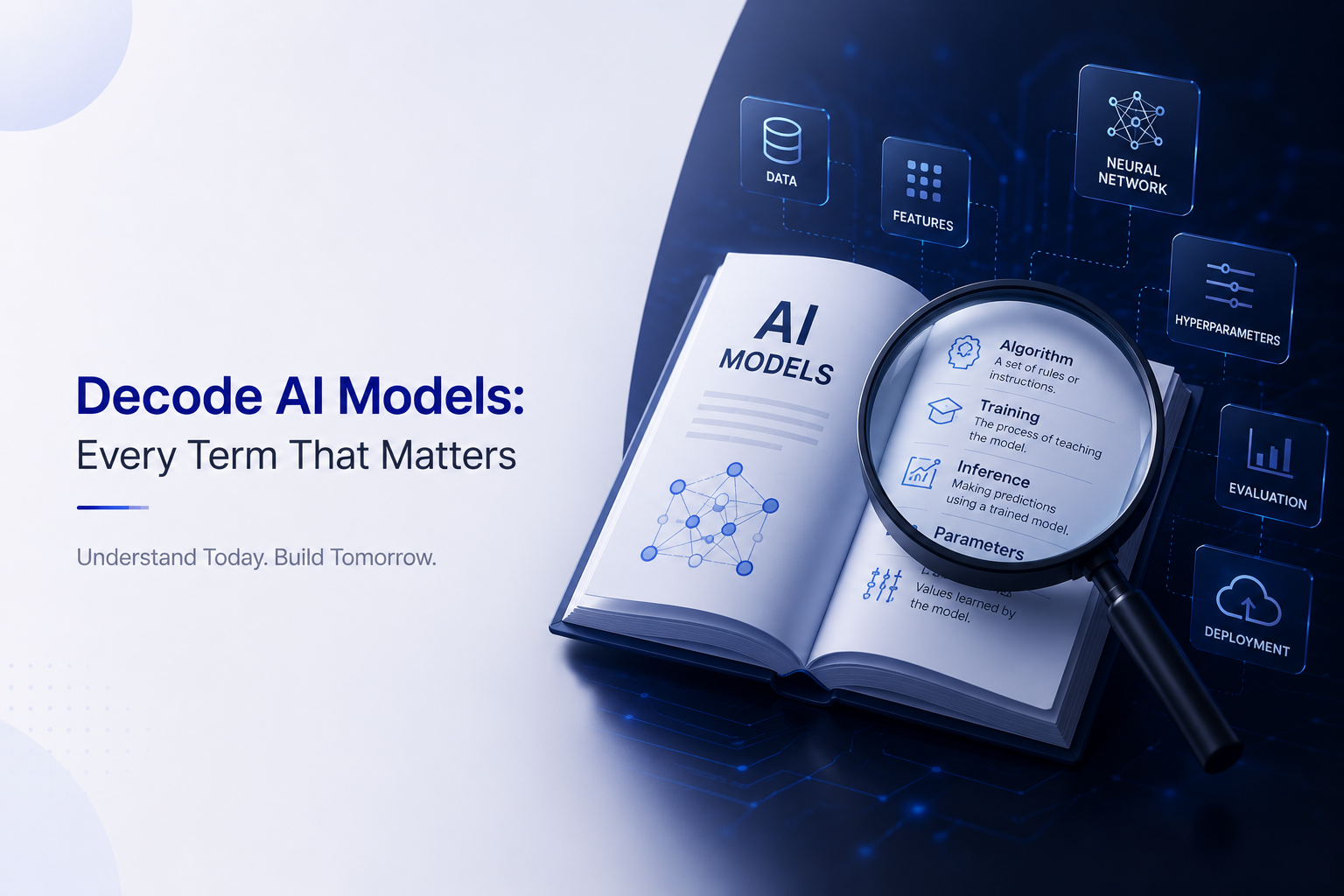
Developers and founders will run into words like parameters, tokens, embeddings, transformers, and context windows. You may also see terms such as RAG, inference, fine tuning, quantization, agents, and multimodal models. Figuring out what each one means, and how it changes an AI system, matters a lot when you build something for production.
Parameters vs. Model Size
Parameters are the numerical values a model learns during training. A model with billions of parameters may require significantly more memory and computing resources.
But a larger parameter count doesn't automatically mean a better model. Training data, architecture, fine-tuning, context handling, and inference strategy also affect model performance.
Tokens and Context Windows
AI models process text as tokens, rather than complete sentences. Tokens influence input and output costs, processing time, and context usage.
The context window defines how much information a model may process in a single request. More context can be useful, but sending unnecessary information can increase cost and latency.
This is why techniques such as chunking, retrieval, caching, and context optimization matter in production AI systems.
Embeddings and RAG
Embeddings turn data into numerical vectors that represent semantic connections. This makes them useful for semantic search.
Retrieval-Augmented Generation (RAG) builds on this idea by retrieving relevant external information before sending it to the model:
User Query → Retrieval → Relevant Data → LLM → Response
For applications that rely on frequently changing information, RAG can be more practical than repeatedly retraining a model.
Inference, Fine-Tuning and Quantization
Training creates a model, while inference is when that trained model generates an output.
Fine-tuning can adapt an existing model for specific tasks, while quantization reduces the numerical precision used by model weights to lower memory and infrastructure requirements.
These choices directly affect latency, cost, hardware requirements, and output quality.
Tools and AI Agents
An LLM normally generates text, but real applications often need to interact with external systems.
With tool calling, an AI system can request actions such as querying an API, retrieving blockchain data, or checking a database.
Agents take this further by combining models, tools, reasoning, and orchestration into a workflow:
Goal → Reason → Select Tool → Execute → Observe → Continue
This distinction is important: an AI model is not the same thing as an AI application.
The Bigger Picture
A production AI system can involve several layers:
Data → Retrieval → Context → Model → Tools → Memory → Evaluation → Infrastructure
This means choosing the largest or most popular model isn't always the right architectural decision.
The right approach depends on factors such as capability, latency, cost, context requirements, reliability, and deployment needs.
Understanding these AI terms gives developers and founders a clearer picture of what actually happens behind an AI-powered application.
Want to understand these concepts in more depth?
Read the full technical breakdown:
Decode AI Models